


2026 Total Solar Eclipse Trip (Page 1 of 2)
--> NEVER LOOK AT THE SUN WITHOUT SPECIALISED VIEWING GOGGLES DESIGNED FOR THE SPECIFIC PURPOSE OF SOLAR OBSERVATION. DOING SO CAN VERY EASILY CAUSE IRREVERSIBLE DAMAGE TO THE EYES. <--
Background
On the 12th August, 2026, a total solar eclipse took place that traced a narrow path across the Northern Hemisphere, passing over Greenland, Iceland and into mainland Europe. This webpage (Page 1 of 2) documents the event as seen from a site in northern Spain, near the city of Burgos (Page 2 follows with photographs of, and text about the different places also seen during this 4-night trip).
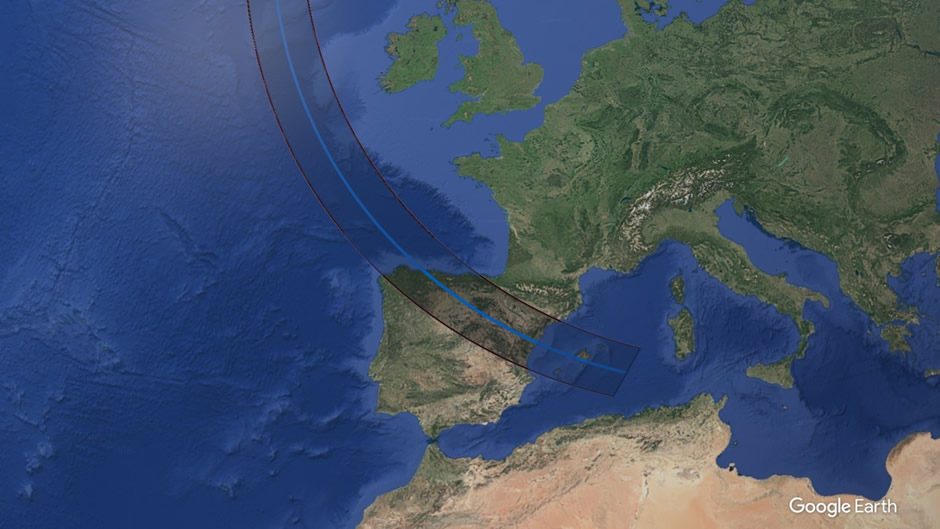
Above: Map showing the path of totality over Spain. Areas of the path such as in the Arctic, eastern Greenland, and the Atlantic Ocean were not practically possible. Western Iceland was not considered due to the unpredictable weather (and in fact, widespread low clouds, thick overcast, and rainy conditions blanketed major viewing areas including Reykjavík, the Reykjanes Peninsula, and Snæfellsnes). Considering sunset times, weather, logistics, and cost, Northern Spain was chosen as the best place to go. Source: References [14] and [17].
The last time a total solar eclipse was visible from Spain was in 1959, making the 2026 event the first opportunity in several generations to witness totality from the country. Whilst a partial solar eclipse was also visible across much of Europe, North Africa and parts of North America, its true phase of totality on mainland Europe reached its greatest prominence across northern Spain.
 |
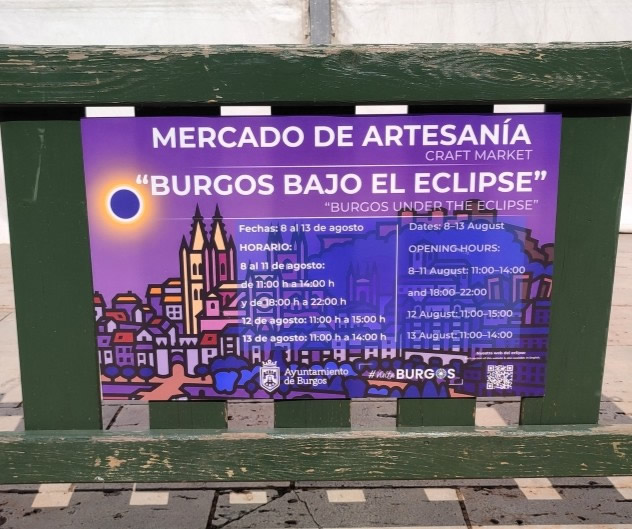 |
Above: Notices relating to the eclipse in Burgos, northern Spain.
The path of the Moon's shadow crossed several
regions of the country, including Galicia, Asturias, Cantabria, the
Basque Country, Navarra, Aragon and northern parts of the Balearic
Islands. Observers within this corridor experienced a brief but striking
period of totality as the Sun was completely obscured. Because the
eclipse occurred in the early evening, the Sun was already low in the
sky, allowing the event to be seen against the horizon rather than
directly overhead.
Although many countries witnessed a partial eclipse, the 2026 event
achieved its true spectacle of totality across northern Spain, where
thousands gathered to observe this rare astronomical phenomenon.
 |
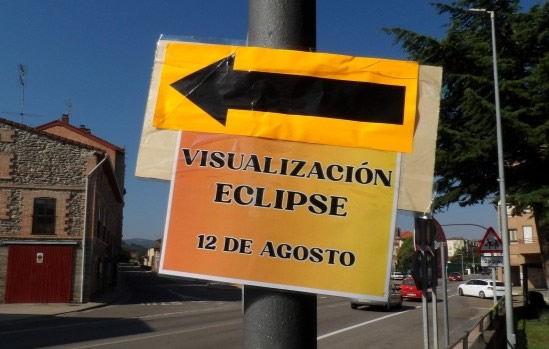 |
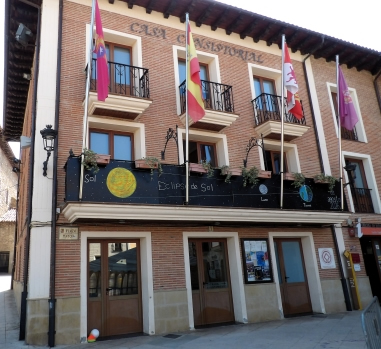
Above: The Town Hall and a sign in Belorado relating to the eclipse. Belorado is a historic town and municipality in the Province of Burgos, Castile and León, Spain. A site was chosen to view the eclipse near here, conveniently adjacent to a youth hostel which has excellent facilities and is located along the famous Camino de Santiago pilgrimage route.
Many people assume that witnessing a deep partial eclipse is the same as experiencing a total eclipse, but astronomers emphasise that the two events are fundamentally different. As eclipse specialist Fred Espenak notes, "A lot of people think they have seen an eclipse. They think they have seen a partial solar eclipse – even if they have seen a 99 percent partial, it pales in comparison to seeing a complete, 100 percent total eclipse of the Sun". This distinction highlights why totality is regarded as a uniquely rare and profound astronomical event. The author of this webpage agrees with many other witnesses of a total solar eclipse spoken to in saying that it is impossible to describe the experience in words.
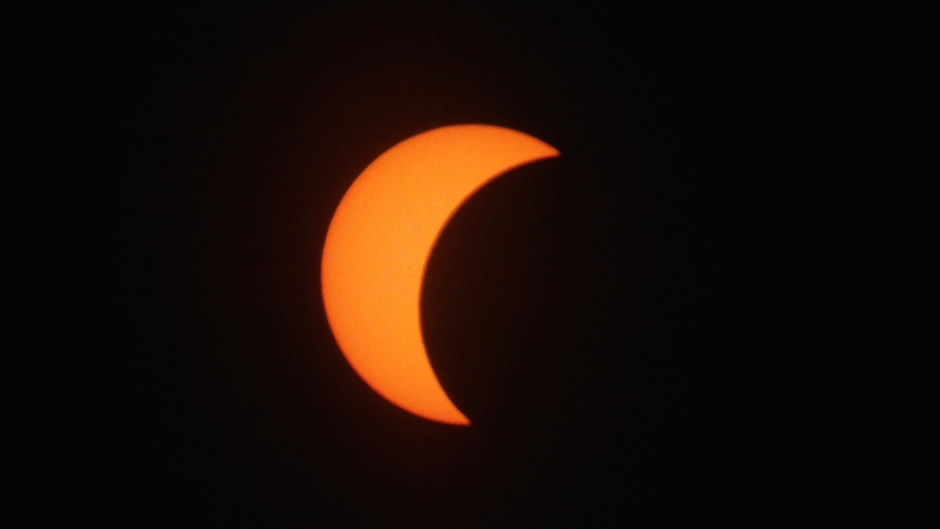
Above: The 12th August 2026 eclipse during partial phase prior to totality. Photo taken with a Kodak PIXPRO AZ528 on automatic setting through a black polymer filter sheet.
This was the second time the author of this
webpage had witnessed a total solar eclipse. An account of the first one
seen and some background regarding what total solar eclipses are and why
they are so rare is given on a previous webpage on the link
Here.
On the first occasion, back in 2017 in Tennessee, photographs of the
eclipse were taken using a camera equipped with an appropriate zoom lens
and a specialised filter sheet used for viewing the Sun through (black
polymer sheet produced by Thousand Oaks Optical and available on
Amazon). For this 2026 eclipse, a video was taken using a DwarfLab DWARF
3 Smart Telescope, equipped with supplied solar filter, which attaches
magnetically. In addition, a few photographs were taken with and without
an identical solar filter sheet with a Kodak PIXPRO AZ528 (selected for
value for money and high zoom) and some general photographs of the site
taken with a smartphone camera – some of the photographs are shown
throughout this webpage. A brief outline of the methodology used to
capture the Dwarf 3 video follows and references, referred to in squared
brackets, may be found at the end of this webpage.
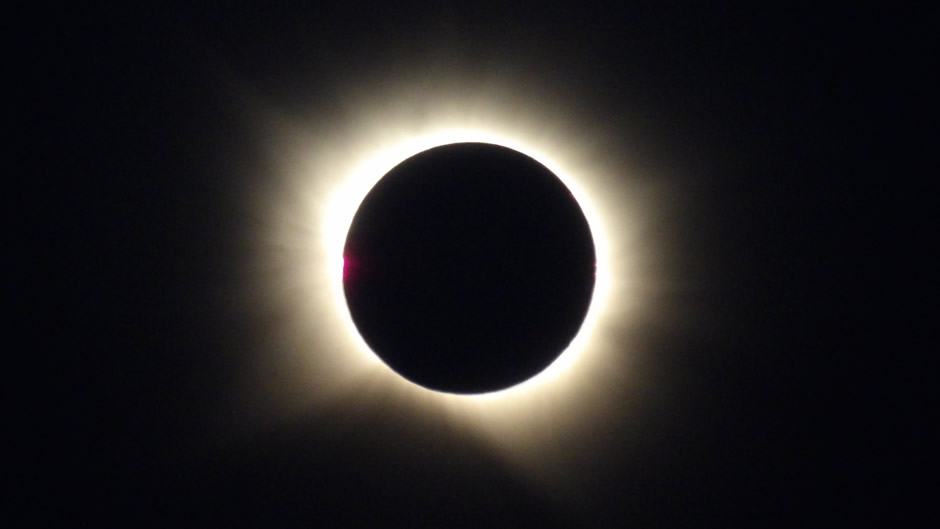
Above: The 12th August 2026 eclipse during totality. Photo taken with a Kodak PIXPRO AZ528 on automatic setting (without filter). In the lower left, the dark part of the Sun’s corona is (believed to be) a coronal cavity - a large, oval-shaped void in the Sun’s outer atmosphere that appears darker because it contains thinner, less dense plasma. It is caused by the magnetic field of a coronal prominence lifting and holding plasma high above the Sun’s surface, creating a hollow region around it.
Video capture – Methodology and Notes
After consulting weather forecasts and giving consideration to the horizon as the eclipse would be shortly before sunset, a suitable location was identified to set up the DwarfLab DWARF 3 Smart Telescope (near the municipality of Belorado at 42°25'03.7"N 3°10'56.6"W or 42.417694, -3.182389). Geographical coordinates from Google Maps [9] were entered into a solar eclipse timer app [8], noting the times (GMT+2) for C1 (19:33:17.7), C2 (20:28:15.8), C3 (20:29:52.9), C4 (21:21:25.1*), and totality midpoint (20:29:04.5), where C1 = start of Partial, C2 = start of totality, C3 = end of totality, C4 = end of partial, and * denoting end of partial would be after sunset.
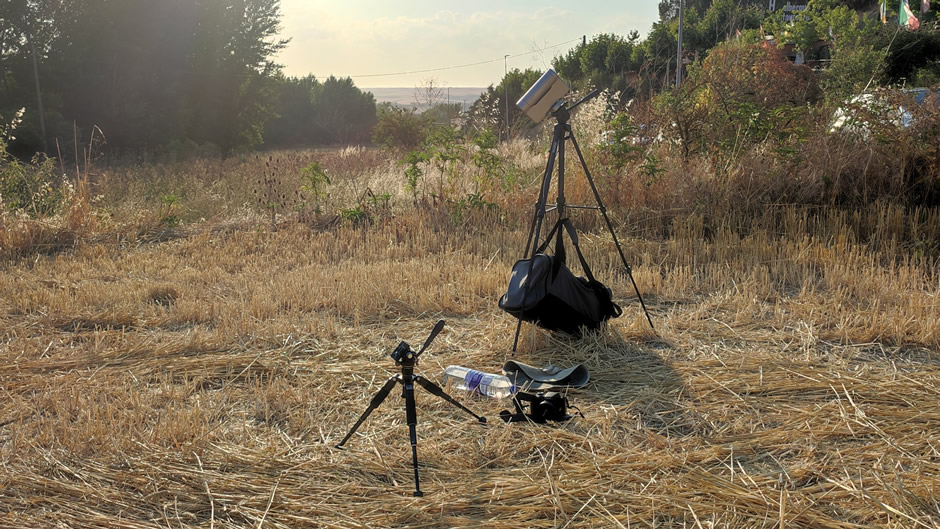
Above: Dwarf 3 setup. Positioned so that sunset is where the horizon is. Perhaps there were better locations, but this one was right next to facilities making the afternoon and evening more comfortable.
EQ mode (Equatorial Mode) is preferred for filming a solar eclipse lasting over an hour with the Dwarf 3, because it prevents field rotation, keeping the Sun and Moon steady and upright in the frame. It also makes post‑processing easier by keeping sunspots and the Moon's path consistently aligned, while providing smoother, more predictable tracking throughout the long partial phases - EQ mode ensures the Moon cuts across the Sun in a perfectly straight, smooth trajectory without any jarring rotational jumps [14].
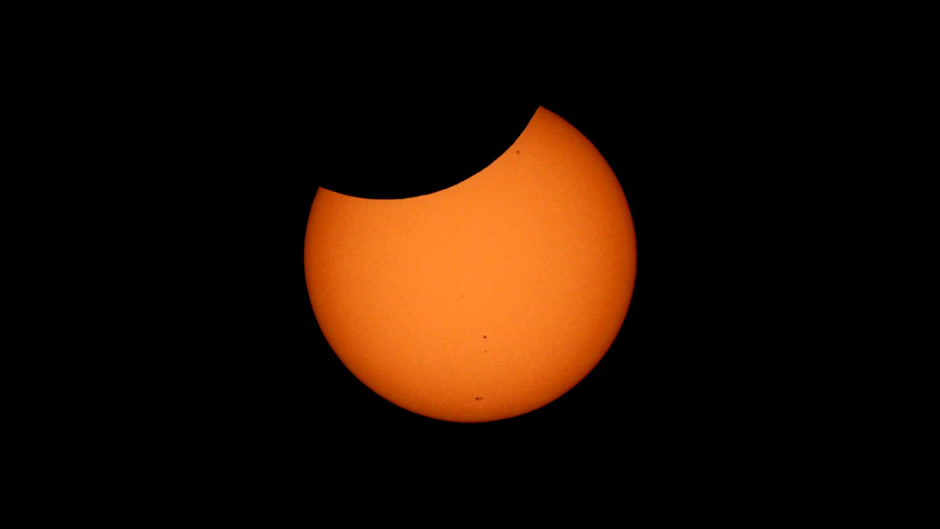
Above: Frame capture from Dwarf 3 video during the first phase of the eclipse, with sunspots clearly visible. Note: Due to the setup of the mount, the rotational orientation is setup such that the horizon is to the upper-left of the photograph.
Ideally, the Dwarf 3 would have been mounted on a DwarfLab tripod, although its short height was deemed unsuitable for the site and the relatively low position of the Sun and Moon during totality. Instead, a camera tripod (PrimaPhoto gear ) was used and set up as follows: The tripod was set level in the field with all legs extended and a bag (approx. 6kg) resting on the ground with straps tightened around the hook below the tripod head for extra stability, whilst using the bubble indicator as a guide. The mounting was then aligned to true north/south, such that the head could tilt upwards when facing north. True north was measured using a digital compass app set to True Heading mode [6]. This was then verified with an orienteering compass, calculating the magnetic declination (magnetic north vs true north) by noting latitude and longitude from Google Maps [9] and elevation [12] and using an online magnetic declination calculator [10]. The Dwarf 3 smart telescope was then attached to the tripod using the tripod mounting plate , with the DwarfLab logo side of the scope facing true north. The wedge was then tilted to match the location’s latitude using an angle meter app [11]. The magnetic solar filter was attached to the scope and then the head of it rotated around the sky to the approximate direction of the Sun, prior to C1. Using the Dwarf 3 app, set to Solar System/Sun, the Sun was centred, autofocus applied, and then AI solar tracking was engaged. Throughout the event, it was necessary to make adjustments to the shutter setting, whilst keeping the gain set at zero. For simplicity, the Dwarf 3 was set to record a video throughout the whole of the event, until sunset, which occurred between C3 and C4. The solar filter was taken off approx. 20 seconds before C2 and replaced approx. 15 seconds after C3, making adjustments to the shutter setting accordingly (1/1000 first partial phase, 1/100 totality, and then second and final partial phase, actually longer exposure times than 1/100 as light levels became lower due to the Sun’s imminent setting below the horizon). After the event, a backup of the video was made to a smartphone immediately, in case the Dwarf 3 were to become damaged during travel after leaving the site.
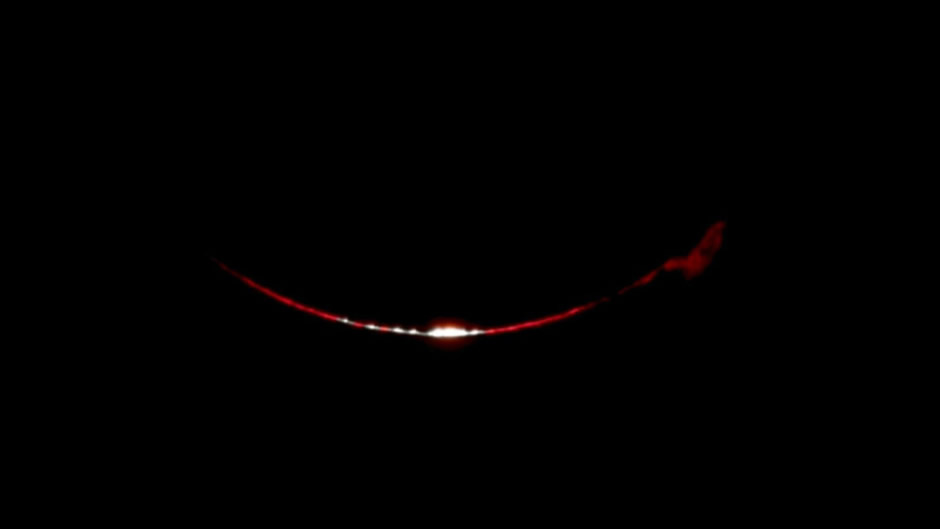
Above: Frame capture from Dwarf 3 video just before totality, showing “Bailey’s beads” (left from centre), which are the bright points of sunlight that shine through the uneven valleys on the Moon’s limb just before and after totality.
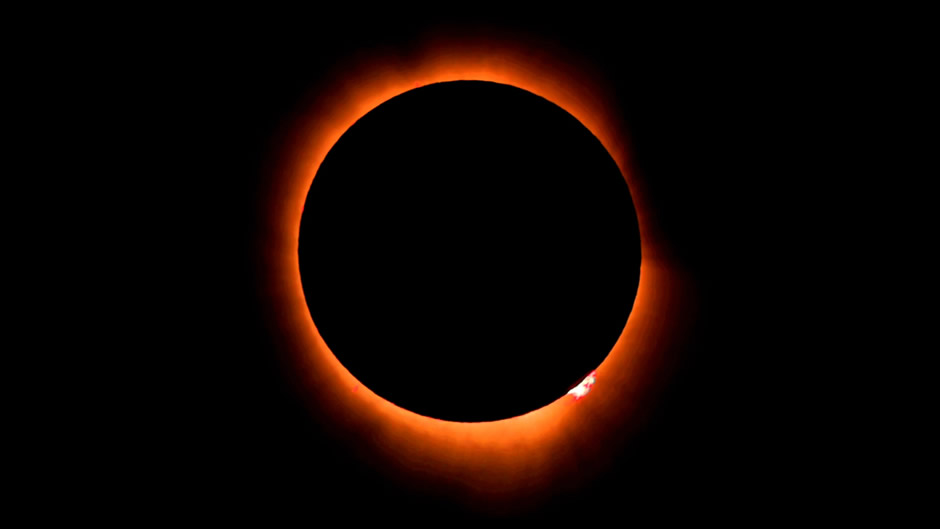
Above: Frame capture from Dwarf 3 video during totality. A solar flare was also visible - a brief burst of intense light along the Sun’s edge. A typical solar flare lasts from a few minutes to several hours.
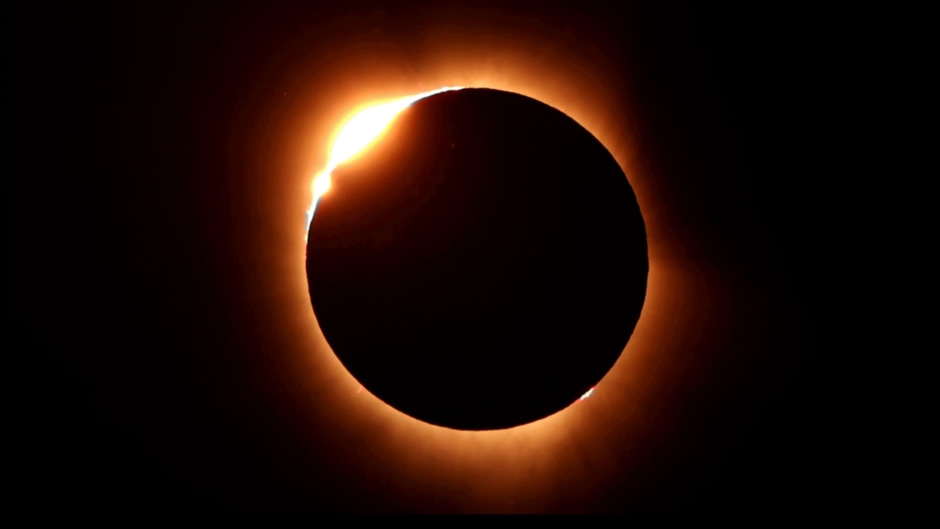
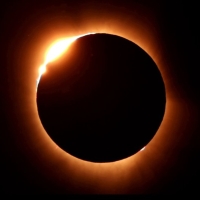
Above: Frame capture from Dwarf 3 video just after totality showing the “Diamond Ring” effect.
Video Processing
An initial video was produced using VSDC video editor [15] with the partial phases shown at x40 speed and the totality at x1 speed as follows: Despite the tripod itself being stable, the hinge part had a minor wobble due to the Dwarf 3 being in a slight breeze. This produced some shaking in the final video. After reducing the duration of the video as per above, a Planetary Imaging PreProcessor tool was used to stabilise the Moon and Sun in the video [16]. The resulting footage was then used to make a YouTube video. Also included in this final video was a Google Earth globe/map zooming into the site using Google Earth Studio [17], with an added layer to show the eclipse path on the map using a KML file downloaded from “Google Maps Path for 2026 total solar eclipse” [14]. The video follows with some clips from the author’s brother and the results are shown below:
Some Final Notes on The Eclipse
The eclipse through the Dwarf 3 appeared somewhat golden in colour. Because the Kodak camera image appeared more like the normal white, it was initially assumed that the golden colour was due to the exposure settings not being high enough, although this phenomenon has been observed and discussed elsewhere as an atmospheric effect due to the Sun’s low position in the sky [18].
There were certainly some improvements that could have been made to the Dwarf 3 filming and these include selecting a tripod that had a more stable hinge on the head part, and during totality perhaps increasing the exposure time to get a whiter and brighter effect. Nonetheless, the author was satisfied with the results and one big bonus was that the settings nicely captured a solar flare. Some other activities planned didn’t happen for various reasons and this included observing tiny projections of the partially covered Sun which are formed when sunlight passes through small gaps, such as between leaves, creating pinhole‑camera crescent shapes on the ground. These crescent shapes can also be observed using a colander (which we didn’t take). Whilst there were some trees around, a quick look revealed no such crescents. Reports point out that the low altitude of the Sun caused light to project horizontally rather than downward onto the ground. This sideways angle meant crescent shadows were cast onto vertical surfaces like walls and tree trunks instead of flat dirt or pavement. Additionally, the increased distance the angled light had to travel through the leaves blurred the images until they completely vanished.
Practicing setting up and filming the Sun at home beforehand, albeit with the shorter DwarfLabs tripod, proved invaluable in making the process run smoother on the day.
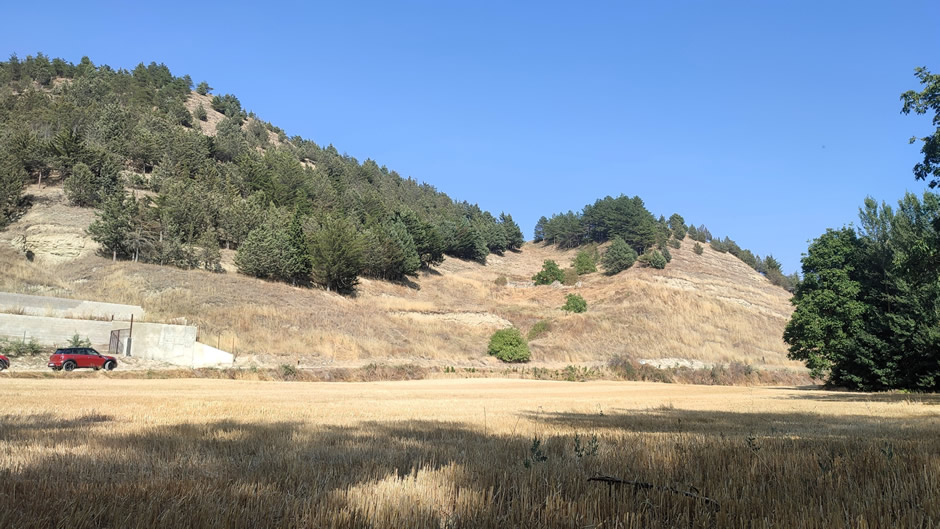
Above: With the final viewing location decided upon and hopes for no last-minute changes in the weather, it was time for a siesta in some nearby shade.
With the time available during totality and limited experience, just concentrating on the Dwarf 3 and taking some quick snaps with the Kodak camera felt enough. Attempting the juggling exercise of any more devices, especially during totality, may have caused some mistakes (e.g. forgetting to take off and replacing the Dwarf 3 solar filter at the right time). The location was good – perhaps it could have been a little higher up, although being right near a good youth hostel made the day easier with facilities to hand. Many people we spoke to seemed to be heading off to a number of popular locations which may be better for the “crowd atmosphere”, but with a small number of people around, the cheers still came whilst not having too many people around to distract us from capturing the shots we wanted.
The 12th August 2026 solar eclipse was called a "double bill" because it coincided directly with the peak of the annual Perseid meteor shower. The night was spent in a remote location and indeed many meteors were seen shooting through the sky, although tiredness had set in and it was decided not to set up any cameras as this spectacle can be seen at home every year, and there was still a buzz of excitement about having witnessed a total solar eclipse that gave the feeling that enough skywatching had been done for the day.
References and Further Reading
Literature:
1. Close, F.E. (2019) Eclipses: What everyone
needs to know. New York, NY: Oxford University Press.
2. Dickinson, T. (2021) The backyard astronomer’s guide (fourth edition,
completely revised and expanded). Firefly Books.
3. DwarfLab (no date) Get Ready with DWARFLAB for the 2026 Total Solar
Eclipse, help.dwarflab.com. Available at:
https://help.dwarflab.com/en/docs/2026-solar-eclipse?product=dwarf-3
(Accessed: 25 July 2026).
4. Espenak, F. (2017) Total Solar Eclipse Quotes. Available at:
https://www.mreclipse.com
(Accessed: 16 August 2026).
5. Sheehan, W. (2026) Solar eclipses. London: Reaktion Books Ltd.
For Dwarf 3 Setup and Filming:
6. Axiomatic Inc. (2026) Digital Compass [App],
Available at:
Google Play Store (Accessed: 12
August 2026).
7. DWARFLAB (2026) DWARFLAB [App], version 3.4.1, Available at:
Google Play Store (Accessed: 12
August 2026).
8. Foxwood Astronomy (2026) Solar Eclipse Timer [App], version 4.1.33,
Available at:
Google Play Store (Accessed: 12
August 2026).
9. Google (2026) Google Maps (Version 26.33.02.961351034) [Mobile app].
Available at:
Google Play Store (Accessed: 12 August 2026).
10. Omni Calculator (n.d.) Magnetic Declination Calculator. Available
at:
https://www.omnicalculator.com/physics/magnetic-declination
(Accessed: 12 August 2026). For more information, visit
omnicalculator.com.
11. Smart Tools factory (2026) Angle Meter [App], Available at:
Google Play Store (Accessed: 12
August 2026).
12. What Is My Elevation?. Available at:
https://whatismyelevation.com/
(Accessed: 12 August 2026).
13. ZWO Seestar, 2026. EQ Mode vs AZ Mode — How to Choose for
Astrophotography with Seestar. [online] Seestar Technical Blog.
Available at:
https://www.seestar.com/blogs/tutorial/eq-mode-vs-az-mode-how-to-choose-for-astrophotography-with-seestar
[Accessed 19 August 2026].
For Video Production:
14. bokombolo (2026) Google Maps Path for 2026
total solar eclipse. Available at:
https://goo.gl/maps/jFpEGKTdehZRNvDF7
(Accessed: 17 August 2026).
15. Flash-Integro LLC (2026) Download Free Video Editor. Available at:
https://www.videosoftdev.com/free-video-editor/download
(Accessed: 17 August 2026).
16. Garry, C. (2022) Planetary Imaging PreProcessor (PIPP) (Version
2.5.9) [64-bit computer software]. Available at:
Astro What? (Accessed: 16 August
2026).
17. Google (no date) Google Earth Studio. Available at:
https://www.google.com/earth/studio/
(Accessed: 17 August 2026).
Other Sources:
18. ScienceDaily, 2026. This total solar eclipse looked strangely golden — here's why. [online] Available at: https://www.sciencedaily.com/releases/2026/08/260820002432.htm [Accessed 22 August 2026].
Link to Page 2 Here
Back to Top
